Here’s something most parents don’t realize: your child does NOT need to know all 26 letters before they start learning to read words.
In fact, once your child knows just a handful of letter sounds, you can start showing them how to put those sounds together to read real words. No memorizing a giant list of preschool sight words. No guessing from pictures. No waiting until they know the entire alphabet.
Just a few sounds + a simple process for putting them together. Let me show you exactly how to start teaching phonics for kids at home.
Step 1: Start With a Few Letter Sounds
You don’t need to teach A–Z before you begin reading words. Instead, start with a small group of letter sounds that can be combined to make lots of simple words.
For example, you might start with s, a, t, p, i, n, b, m, e, d.
Once your child knows these sounds, they can begin reading words like sat, tap, pin, map, bed, tip, nap, and pat. Your child just went from knowing a handful of sounds to being able to read actual words!
These simple three-letter words are called CVC words. CVC stands for consonant-vowel-consonant, which is simply the pattern you see in words like m-a-p, p-i-n, and b-e-d.
Your child doesn’t need to know the term “CVC pattern” to learn to read them. They just need to know the letter sounds and what to do when they see the word.
CVC Words List by Short Vowel
As your child learns more letter sounds, you can use this CVC words list for practice:
| Short Vowel | CVC Words |
|---|---|
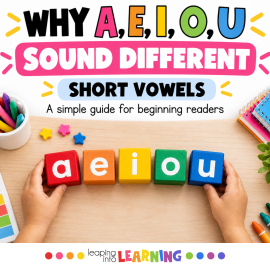
| a like apple | cat, map, bat, hat, rat, cap, man, tap, sad, pan |
| e like egg | bed, pen, red, net, hen, leg, den, vet, men, peg |
| i like igloo | pin, sit, tip, win, pig, lip, kit, fin, rid, dig |
| o like octopus | pot, top, log, hot, dog, mop, rod, cop, box, hop |
| u like umbrella | sun, bug, cup, mud, rug, hug, bun, tub, cut, fun |
If you’re looking for CVC words for kindergarten or preschool practice, here’s the most important thing to remember: only give your child words made from letter sounds they already know.
We want them practicing reading CVC words, not guessing at letters they haven’t learned yet.
Step 2: Teach Your Child How to Sound Out CVC Words
Knowing that p says /p/ and i says /i/ is important, but knowing individual letter sounds isn’t the same as reading. Your child also needs to learn how to blend those sounds together to make a word.
Instead of showing your child pin and asking, “What word is this?” show them exactly how to figure it out.
Point to the letters and start with /p/. Then blend the first two sounds together: /pi/. Finally, add the last sound: /pin/. “Pin!”
This is called successive blending, but you definitely don’t need to remember that name. What matters is that your child doesn’t have to hold three separate sounds in their head and somehow smash them together at the end. You’re helping the word build as they go.
If they need some help, model it first. Say, “Watch me. /m/… /ma/… map. Now you try.”
This is one of the most important early skills for a child learning to read, and you can practice it for just a few minutes at a time.
Step 3: Help Them Connect the Sounds to the Letters
Now we’re going to help your child understand something really important: words aren’t random things we memorize. The letters in a word represent the sounds we hear.
Take the word bat. Say it slowly together: /b/ /a/ /t/. Ask, “What sound do you hear first?” When your child says /b/, ask, “What letter spells /b/?” Then do the same thing with /a/ and /t/.
You can make this visual by drawing three simple boxes: □ □ □. Your child says one sound for each box and then writes or places the matching letter inside.
This is called word mapping. The technical term is phoneme-grapheme mapping, but you absolutely do not need to remember that to help your child do it. You’re simply helping their brain connect the sounds they hear to the letters they see.
Over time, those connections help words become easier and faster to read. That’s very different from trying to memorize a long list of words by sight.
Step 4: Use CVC Worksheets for Extra Practice
CVC worksheets can be a great way to practice—as long as they’re helping your child use the reading skills you’re teaching instead of encouraging them to guess.
Look for CVC words worksheets that ask your child to sound out words, match sounds to letters, build words, write words, or change one sound at a time.
For example, your child might read map, then change one letter to make mat, and then change another to make sat. This helps them notice how changing just one letter changes the word.
You can also use short vowel worksheets to practice words with a, e, i, o, and u. And if you’re searching for kindergarten phonics worksheets or phonics worksheets, look for ones that match the sounds your child has already learned rather than pages filled with words they aren’t ready to decode yet.
The worksheet itself isn’t what teaches your child to read. It’s what your child is doing with the words that matters.
So whether you’re using paid or free CVC worksheets, ask yourself: Is my child actually looking at the letters, saying the sounds, and reading the word?
If yes, you’re on the right track.
Step 5: Make CVC Word Practice Feel Like Play
You don’t have to rely on worksheets every day. CVC word games are another easy way to get in some practice without making reading time feel like more school.
Try building CVC words with magnetic letters, writing words on sticky notes and hiding them around the room, or playing “change the word.” Start with map, change one letter to make mat, and then change another to make sat.
You can also use CVC pictures for matching games. Just make sure your child reads the word before using the picture to find the answer.
Pictures are great for helping kids understand what a word means. They shouldn’t be how your child figures out what the word says.
A few minutes of playful practice is plenty. You don’t need to turn your kitchen table into a classroom.
Step 6: Read CVC Words in Kids Books
Worksheets and word games give your child practice, but ultimately we want them to use those skills for the thing that really matters: reading books.
The key is choosing the right kids books.
When your child is just beginning to read, look for decodable books that contain the letter sounds and word patterns they’ve already learned. That gives your child a chance to actually use their phonics skills instead of relying on pictures, memorized sentences, or guessing.
For example, if your child knows the sounds for s, a, and t, they can sound out sat. That moment when they realize, Wait… I just READ that! is huge.
We want your child to look at an unfamiliar word and think, “I know how to figure this out,” instead of, “Maybe the picture will tell me.”
What Comes After CVC Words?
Once your child can comfortably read simple words like map, sit, and bed, you might find yourself wondering, Okay… now what?
That’s when you can start building on what they already know and introduce slightly more complicated words. Eventually, they’ll be ready for words like fast, hand, milk, and jump, then more advanced spelling patterns as their skills grow.
The goal isn’t to have your child memorize more and more words. It’s to give them a process they can use to figure out words they’ve never seen before.
Less guessing. Less memorizing. More actual reading.
Grab a Free Kids Book and Start Reading
Ready to try this with your child?
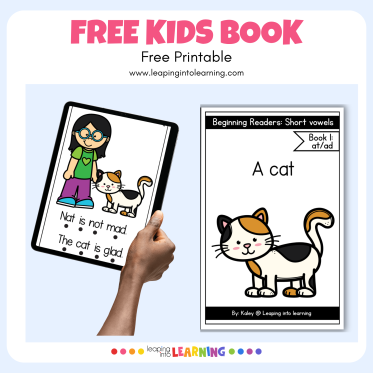
I’ve made it easy for you to start. Grab my free kids book and give your child a chance to practice the sounds and reading skills they’re learning in an actual book.
[GET YOUR FREE KIDS BOOK]
You don’t need to know everything about teaching reading before you begin. Start with what your child knows, practice for a few minutes, and build from there.
And if you’re thinking, This makes sense… but I still don’t know what I’m supposed to teach next, that’s exactly what my reading programs are for.
Instead of piecing together phonics worksheets, CVC worksheets, word lists, and random activities from the internet, I’ll give you the step-by-step plan.
What to teach. What to say. What comes next.
My Complete Reading Program takes your child from learning their first letter sounds to reading increasingly complex words and text—with simple lessons designed for busy parents to use in about 10 minutes a day.
You bring the kid. I’ll bring the plan.