
If your child is learning the 3 sounds of ed, you might be wondering why this tiny little suffix ed seems to change its sound all the time. Sometimes it says /t/, sometimes /d/, and sometimes /id/. What is going on?!
Good news: this is NOT random. The ending sounds of -ed follow a rule. And once you know it, you can easily help your child at home.
Let’s break it down in the simplest way possible.

First: What Is the Suffix ED?
The suffix ed is added to a word to show that something already happened.
- jump → jumped
- play → played
- want → wanted
But here’s the important part: we do not always say “ed” the same way.
There are 3 sounds of ed:
- /t/
- /d/
- /id/
That’s it. Just three.
Sound #1: /id/ (This One Adds a Whole Extra Syllable)
This one is the easiest to hear.
If the base word ends in t or d, we say /id/.
- want → want-id
- need → need-id
- land → land-id
You can hear the extra beat. Clap it:
want-ed (2 claps)
If your child hears two syllables, it’s probably the /id/ sound.
Sound #2: /t/
If the base word ends in an unvoiced sound (a sound where your throat is quiet), the -ed says /t/.
Examples:
- jump → jumped
- kiss → kissed
- wash → washed
- laugh → laughed
Put your hand on your throat and say the last sound of “jump.”
Your throat is quiet. That’s unvoiced.
So the ending sounds like /t/: jumped.
Sound #3: /d/
If the base word ends in a voiced sound (your throat is buzzing), the -ed says /d/.
Examples:
- play → played
- call → called
- clean → cleaned
- love → loved
Put your hand on your throat and say the last sound in “love.”
Feel that buzz? That’s voiced.
So we add /d/: loved.
How to Teach the 3 Sounds of ED at Home (Without Overwhelm)
You do NOT need to give a giant phonics lesson. Small and simple works beautifully.
Here are easy, hands-on ways to practice:
1. Map the Word (Say It. Tap It. Count It.)
Use the routine on the second page of the free chart:
Say it. Tap it. Count it. Map it. Blend it. Write it.
For example: jumped
Say it: jumped
Tap the sounds: /j/ /u/ /m/ /p/ /t/
Count them: 5 sounds
Map each sound into a box
Blend it back together
This helps your child hear that even though we see “ed,” we only hear /t/.
This builds strong sound-symbol connections — which is exactly what good readers need.
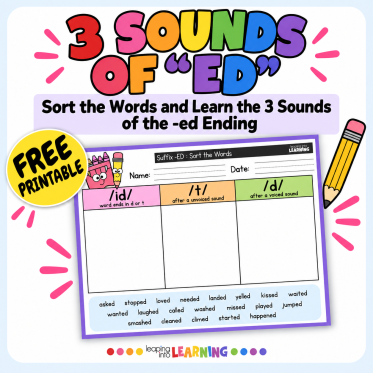
2. Sort by Sound
- /id/ (word ends in d or t)
- /t/ (after an unvoiced sound)
- /d/ (after a voiced sound)
Cut the words apart and sort them by sound.
Ask:
“What sound do you hear at the end?”
Not:
“What letters do you see?”
We want their ears leading the learning.
Sorting builds pattern recognition — and reading is all about noticing patterns.

3. Make a Simple Anchor Chart
Grab a piece of paper and divide it into 3 columns:
/id/ | /t/ | /d/
Have your child help you add words throughout the week.
Keep it messy. Keep it growing. The goal is repetition and noticing.
When kids SEE the pattern again and again, it sticks.
4. Use Real Life Moments
When you’re reading together and see a past tense word, pause and ask:
“How does that -ed sound?”
Just 5 seconds of noticing makes a difference.
No worksheets required.

Why This Matters
Understanding the 3 sounds of ed helps kids:
- Spell past tense words correctly
- Decode longer words
- Understand ending sounds clearly
- Build confidence
And most importantly — it shows them that English has patterns.
Reading is not memorizing a million words. It’s learning the code.
And the suffix ed is part of that code.
You’ve Got This
If this feels new to you, that’s okay. Most of us were never taught the why behind reading.
But you absolutely can support your child with this.
Start small. Sort a few words. Tap a few sounds. Add to a chart.
Little moments add up.
And if you’d like something ready to use, grab the free 3 sounds sorting chart above and try it this week.
You can do this. And your child can too.


Leave a Comment
You must be logged in to post a comment.