If you want to help your child learn to read but keep wondering, “What am I actually supposed to teach next?”—this is for you.
You don’t need a teaching degree or hours of reading activities. You need a simple plan. Because learning to read isn’t about memorizing hundreds of words. Kids need to learn how words work—starting with letters and sounds and gradually building up to trickier spelling patterns.
Here’s a simple roadmap you can use at home.
How to Teach Reading to Kids: What Comes First?
A helpful reading progression looks something like this:
- Letter names + sounds
- Blending simple words with short vowel sounds
- Consonant blends
- Digraphs
- Magic E
- Bossy R
- Vowel teams
Your child doesn’t have to master every single thing before moving forward, but these skills build on each other. So if reading suddenly feels really hard, looking back at the earlier skills can help you figure out where the problem started.
Let’s break it down.
1. Start With Uppercase and Lowercase Letters + Sounds
Before kids can read words, they need to understand that letters represent sounds. Start by helping your child recognize uppercase and lowercase letters and learn the most common sound for each letter.
For example:
- B → /b/ as in bat
- M → /m/ as in mom
You don’t have to wait until your child knows every single letter perfectly before beginning to work with words. As they learn enough letters and sounds, you can start showing them how those sounds come together. That’s when reading starts to click.
2. Teach Short Vowel Sounds + Simple Words
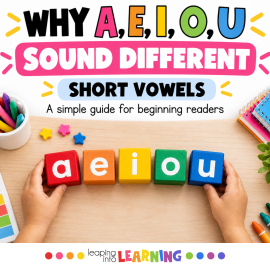
Once your child knows some letter sounds, start building simple words with short vowel sounds. These are the vowel sounds you hear in words like:
- a → cat
- e → bed
- i → sit
- o → hot
- u → cup
Instead of teaching your child to memorize cat as one big shape, help them connect each spelling to its sound: c – a – t → /c/ /ă/ /t/ → cat.
This is a HUGE shift. Your child isn’t memorizing the word—they’re learning how to read it.
3. Move Into Consonant Blends (Word Blends)
Once your child can read simple words like cat, bed, and sit, you can introduce words with consonant blends, sometimes called word blends.
A consonant blend is simply two or more consonants next to each other where you can still hear each sound.
- st → stop
- fr → frog
- bl → black
- gr → grin
In stop, for example, your child needs to hear and connect all four sounds: /s/ /t/ /ŏ/ /p/. This can be tricky at first because there are more sounds to hold onto and blend together.
If your child reads stop as sop or frog as fog, don’t jump straight to memorizing the word. Slow it down and help them listen for every sound.
4. Teach Digraphs: Two Letters Working Together
Next, you’ll start seeing words with digraphs. Don’t worry about whether your child knows the word digraph. What matters is understanding how the letters work.
Unlike consonant blends, where you hear both consonant sounds, a consonant digraph has two letters representing one sound.
- sh → ship
- ch → chop
- th → thumb
- wh → when
Here’s the difference: In stop, you can hear /s/ and /t/. In ship, the s and h work together to represent /sh/.
Once your child understands that, words like shop, chin, bath, and when become much easier to figure out.
5. Add Magic E Words
Next up: Magic E. You may also hear these called silent-e words.
Compare cap → cape. That final e changes the vowel sound. You can practice with pairs like:
- cap → cape
- kit → kite
- hop → hope
- cub → cube
The goal isn’t for your child to memorize a giant list of Magic E words. You want them to notice the spelling pattern and use it to figure out unfamiliar words too.
That gives them a strategy instead of another list to memorize.
6. Learn Bossy R Words
After your child is comfortable with short vowels and patterns like Magic E, you can start working with Bossy R words. You may also hear these called R-controlled vowels.
These are patterns like ar → car, or → corn, er → her, ir → bird, and ur → turn.
The important thing for your child to notice is that adding r changes the sound they might expect the vowel to make. Instead of guessing, they learn to recognize the spelling pattern and connect it to the sound.
7. Tackle Vowel Teams
Now your child is ready for even more ways to spell vowel sounds. This includes common vowel teams like ai → rain, ee → feet, oa → boat, and ay → play.
This is where English can start feeling confusing. The same vowel sound can sometimes be spelled in different ways—and the same spelling can sometimes represent different sounds.
That’s why teaching kids these patterns explicitly is much more helpful than telling them to memorize each new word. Over time, they build a bigger toolbox for figuring words out.
What If My Child Is Struggling With Reading?
This is the part I really want parents to remember: Sometimes kids don’t need more practice. They need different instruction.
If you’ve read the same books over and over, practiced sight word flashcards, or told your child to “sound it out” 100 times and they still aren’t getting it, don’t assume they just need to practice more. Go back to the skills.
- Can they connect letters to sounds?
- Can they blend three sounds into a word?
- Do short vowel sounds trip them up?
- Are they dropping sounds in words with consonant blends?
- Do they know what to do when they see sh, ch, or th?
Finding the skill that’s shaky gives you something much more useful than “practice reading more.” It tells you what to teach next.
The Reading Tip I Want Every Parent to Know
You don’t need to teach your child everything at once. Start with what they know. Build what comes next.
That’s the whole idea behind effective reading instruction. Instead of asking kids to memorize their way through reading, we teach them how letters and sounds work together so they have a strategy for figuring out new words.
And you don’t have to figure out the sequence on your own. What to teach. What to say. What comes next.
That’s exactly what I walk parents through inside the Complete Reading Program—with short, simple lessons designed to make teaching reading at home actually feel doable.
You bring the kid. I’ll bring the plan.