If your child is reading words like “boat” as “buh-ow-t” or “meat” as “meh-a-t,” you’re not alone—and they’re not doing anything wrong. They’re just bumping into long vowel sounds and one of the trickier phonics patterns: vowel teams. These are pairs of vowels (like oa or ea) that work together to make a single sound—and they show up in so many common words your child will need to read.
The good news? Once you know what vowel teams are and how to teach them in a simple, hands-on way, your child can go from confused to confident. Let’s break it down together.
What Are Vowel Teams?
In simple terms, vowel teams are when two (or more) vowels appear together in a word and make just one vowel sound—most often a long vowel sound, where the vowel says its name.
You might’ve heard the old phrase:
“When two vowels go walking, the first one does the talking.”
But here’s the thing—that “rule” only works about 60% of the time. It’s true for some vowel teams like oa in boat or ai in rain, but it doesn’t work at all for others, like ea in bread or ie in field. That’s why we don’t teach guessing rules—we teach patterns that kids can actually rely on.
Understanding vowel teams helps kids break free from guessing and gives them the tools to read real, everyday words more confidently. If your child is learning to read at home and hitting words that don’t sound the way they look, vowel teams are probably the missing piece.
Common Vowel Teams That Make Long Vowel Sounds
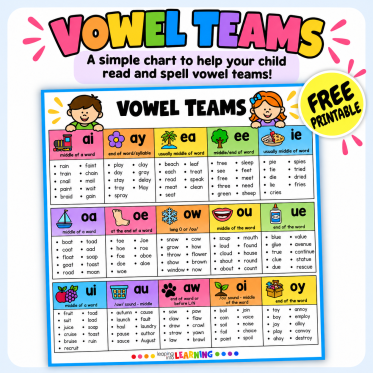
Here are some of the most common vowel teams your child will see—especially in long vowel words:
| Vowel Team | Sound | Examples |
|---|---|---|
| ai | Long A | rain, train, paint |
| ay | Long A | play, tray, day |
| ee | Long E | tree, feet, sleep |
| ea | Long E (usually) | eat, meat, beach |
| oa | Long O | boat, toad, coat |
| oe | Long O | toe, goes |
| ie | Long I | pie, tie |
| ue | Long U | glue, blue |
| ew | Long U | chew, new |
Some vowel teams can make more than one sound, which is why teaching them explicitly—not relying on guesswork—is so important.
Need an easy way to keep track of them all?
Grab your free printable vowel teams chart here.

Why Vowel Teams Are So Important
When kids start reading, they usually begin with short vowel words like cat, dog, or mug. But as they move into more complex reading, they bump into longer words like train, meat, or blue. That’s where vowel teams come in.
Learning these patterns:
- Helps kids read long vowel words without guessing
- Gives them confidence to decode unfamiliar words
- Builds a strong foundation for reading fluency
If you’ve been working on a long and short vowels list or trying to help your child figure out the difference between short and long vowels, teaching vowel teams is the next step that makes everything start to click.
Hands-On Ways to Teach Vowel Teams at Home
No need for fancy tools—here are a few easy, play-based ways to practice vowel teams at home:
1. Word Scoops
Cut out paper ice cream scoops and write vowel teams on each one (like oa, ee, ai). Then write matching long vowel words on cones. Your child can match the scoop to the correct cone (example: boat goes with oa).
2. Word Sorts
Write 10–15 vowel team words on notecards. Ask your child to sort them into piles: ai words, oa words, ee words, and so on. Say the words out loud together and highlight the vowel team in each one.
3. Roll & Read
Label a die with vowel teams (like ay, oa, ue, etc.). When your child rolls the die, they say or write a word with that vowel team—or look for one in a book you’re reading together.
4. Build-a-Word with Mapping
This is a great way to combine reading and spelling! Say a word like rain or boat slowly and stretch out the sounds together. Then have your child build the word using letter tiles or magnets—one sound at a time.
They’re not just building a word—they’re mapping the sounds to letters, which helps solidify the connection between what they hear and what they see.
Want a fun and easy way to practice this?
Use these Vowel Teams worksheets to practice Orthographic Mapping.

5. Use Decodable Books
The best way to help your child apply what they’re learning is to read words with those patterns in context. That’s where decodable books come in.
My long vowels decodable books are printable and follow these patterns step-by-step. Grab them here.

A Quick Look at Short and Long Vowels
If you’re still trying to sort out the difference between short and long vowels, here’s a simple guide:
| Short Vowel | Long Vowel |
|---|---|
| a = apple | a = cake (long a sound words) |
| e = elephant | e = tree |
| i = igloo | i = pie |
| o = octopus | o = boat |
| u = umbrella | u = glue |
Looking at a long and short vowels list side-by-side can help your child spot the difference. Once they understand the basic contrast, vowel teams are the perfect next step.
Ready to Help Your Child Master Vowel Teams?
Vowel teams might seem tricky at first, but with a little support and a lot of practice, they’ll become one of your child’s favorite reading “aha!” moments.
Here’s everything you need to get started:
- Download your free vowel teams chart
- Grab my Phonics Spelling Pack for more help with phonics patterns
- Get long vowels decodable books for real reading practice
You’ve got this, and your child is lucky to have you helping them learn to read in a way that actually makes sense. No guessing. No overwhelm. Just clear patterns and playful practice.
You’ve Got This!
Teaching vowel teams doesn’t have to feel like a mystery. With a little structure and a whole lot of fun, you can help your kids become confident, capable readers.
And hey—don’t worry if they don’t get it right away. These bestie vowel pairs can be tricky, but with practice and encouragement, they’ll click.
You’re doing great. Now go forth and conquer those long vowels!