Easy Ways to Teach the Magic e (With a Cute Song!)
If your child is learning to read, you’re going to love this little moment: when they discover what silent e does in words — and suddenly cap becomes cape, kit becomes kite, and hop becomes hope! These special patterns are called Magic e words, and once kids see how predictable they are, reading gets so much easier.
In phonics, silent e is the quiet letter at the end of a word that makes the vowel say its name — that’s the magic! It’s also called a Bossy e or a split digraph — just a fancy way of saying the vowel and the e are working together, even though a consonant sits between them.
Sing This Cute Song Together
Here’s a little tune you can sing with your child while you practice the pattern. Bonus points if you add claps or a silly voice!
“Pushy e plays a game
and makes the vowel shout its name!”
Sing it as you flip from cap → cape or hop → hope. It helps kids feel the change as well as hear it — and that connection is powerful.
What Are Magic e / Silent e / Bossy e / Split Digraphs?
These all refer to the same pattern:
- A short word with one vowel (like mad, fin, tub)
- Add a silent e at the end (made, fine, tube)
- The vowel says its name — the long vowel sound
These are called Magic e words because that little e is quiet but mighty. It changes everything.
Using clear terms like Magic e, silent e, or split digraph helps your child understand both the spelling and the sound — and that’s exactly what effective reading instruction is built on.
Easy Ways to Teach Silent e & Magic e at Home
Here are simple, science-backed strategies you can try at home — no teaching degree required.
1. Whiteboard Word Flips
Write a short word like hop. Ask your child to read it. Then, add a silent e — hop → hope. What changed? Practice flipping words together: mad → made, pin → pine, cap → cape.
2. Magic e Detective
Grab a decodable reader or phonics book for kids and go on a hunt for Magic e words. Have your child highlight or underline them. You’re helping them connect spelling with sound, which is a big step in learning to read.
3. Word Ladder Fun
Start with a base word and change one letter at a time:
kit → kite → bite → bike → like
It’s playful and helps reinforce spelling patterns.
4. Use Phonics Books for Kids
Look for phonics books for kids that focus on the Magic e or Bossy e rule. Decodable books are designed for exactly this kind of practice — applying what they’re learning in real reading.
5. Silly Word Challenge
Try this:
“What happens if we add a magic e to slim?”
Let them try reading both versions and decide if it’s a real word. If not — no worries! You’ve still helped them practice decoding.
Magic e Word List (Free Download)
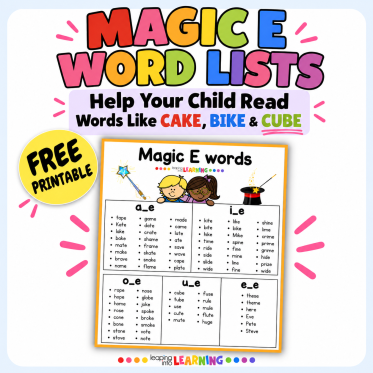
Want a ready-to-go list of Magic e words? Here’s a sneak peek of what’s inside the free printable you can grab today:
Magic e Words with A
- mad → made
- cap → cape
- tap → tape
- can → cane
- pan → pane
Magic e Words with E
- pet → Pete
- met → mete
- led → lede (less common)
- red → rede (less common but useful for decoding practice)
Magic e Words with I
- kit → kite
- fin → fine
- bit → bite
- pin → pine
- rid → ride
Magic e Words with O
- hop → hope
- cod → code
- not → note
- rob → robe
- mop → mope
Magic e Words with U
- tub → tube
- cut → cute
- cub → cube
- us → use
- hug → huge
You can use these for word cards, matching games, or whiteboard practice. They’re included in the freebie along with tips for fun ways to use them at home.
Get the Free Magic e Word List
Download your free Magic e word list right here. It’s organized by vowel sound and perfect for word building, reading practice, or quick games after school.
Plus, it pairs perfectly with decodable readers and phonics books for kids that support the science of reading.
You’re Doing an Amazing Job
Helping your child learn to read doesn’t have to be overwhelming. With simple tools, playful routines, and a little song here and there, you’re giving your child the skills they need to become a confident, lifelong reader.
You’ve got this — and I’m cheering you on every step of the way.